

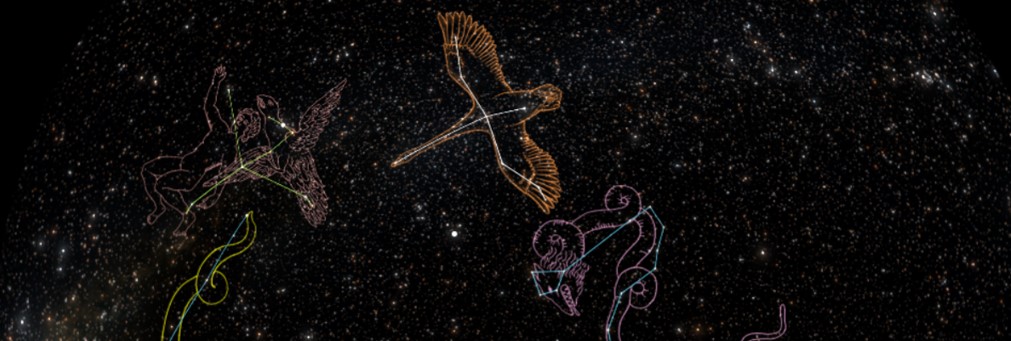
Do you know that there is a starry animal kingdom shining in the sky! Constellations are patterns created by our ancestors with their imagination to connect neighboring stars in the sky. To facilitate the identification and recording of celestial objects, the International Astronomical Union (IAU) officially defined 88 constellations in the entire sky. Among these, about half are named after animals.
For instance, the constellation Canis Major radiates brilliantly in the winter sky over Hong Kong. Its name means “the Great Dog” in Latin, and it is one of the hunting dogs that follows the hunter Orion in mythology. By locating Sirius, the brightest star in the mouth of Canis Major and also the brightest star in the night sky, you could easily find the rest of the Great Dog.
The scenario of hunting dogs chasing their prey appears in the starry sky as well, with Canis Major pursuing Lepus (the hare)! Lepus is located beneath the legs of Orion. Yet, it is not easily recognizable due to its dimness. You need to go to a place with less light pollution to observe it. First, identify Orion among the stars, then find Lepus below.
_r.png)
Marine creatures are something that can’t be missed in the animal kingdom! Let’s take a look at two lovely fish constellations in the southern hemisphere — Volans and Dorado. They create an interesting scene in the starry night: Volans (the flying fish) is jumping out of the water, trying to escape from its predator, Dorado (the sailfish). As both are faint constellations, we suggest first locating the second brightest star in the night sky, Canopus. This bright star is part of Carina, the constellation next to Dorado. Then, turn your gaze to the brightest star in Dorado, the α star. You should be able to see the body of the sailfish and the dim Volans nearby. You may refer to the picture below for the step-by-step guide.
_r.png)
Only four animal constellations are mentioned here due to limited space. Many more starry animals are waiting for you to discover and explore! By using a star map or the Space Museum's “Star Hoppers” mobile application at night, you can visit the starry animal kingdom!