

When you think of Saturn, you probably picture its dazzling rings. But in 2025, those rings seemed to vanish for those of us looking from Earth on three occasions. This was actually an illusion caused by how our planet lined up with Saturn and the Sun.
Saturn’s rings at a glance
The planet’s rings consist mainly of ice chunks, rock fragments and dust particles ranging from tiny grains to house-sized boulders. These materials likely came from shattered comets, asteroids or moons destroyed by Saturn’s powerful gravity. The debris formed an extensive ring system.
The main rings that are visible from Earth stretch about 280,000 kilometres across—that is nearly three-quarters of the distance from Earth to the Moon. Despite their enormous width, the rings are incredibly thin, averaging only 10 metres in thickness. To put this in perspective, if Saturn were the size of a basketball, its rings would be thinner than a sheet of paper. This thinness is why the rings can seem to disappear.
Why does it look like the rings vanish?
The “disappearing” rings result from an astronomical event called “ring-plane crossing”.
Saturn takes 29.5 Earth years to orbit the Sun and is tilted on its axis by about 26.7 degrees. This tilt means that as Saturn travels around the Sun, we see the rings from different angles: sometimes from the north, sometimes from the south and occasionally at its edge. When we see the rings from their edges, they are so thin that they almost become invisible, even through powerful telescopes. It is like trying to see a sheet of paper when looking directly at its edge—you might see just a thin line or nothing at all. From our view on Earth, the ring system simply vanishes from our sight.
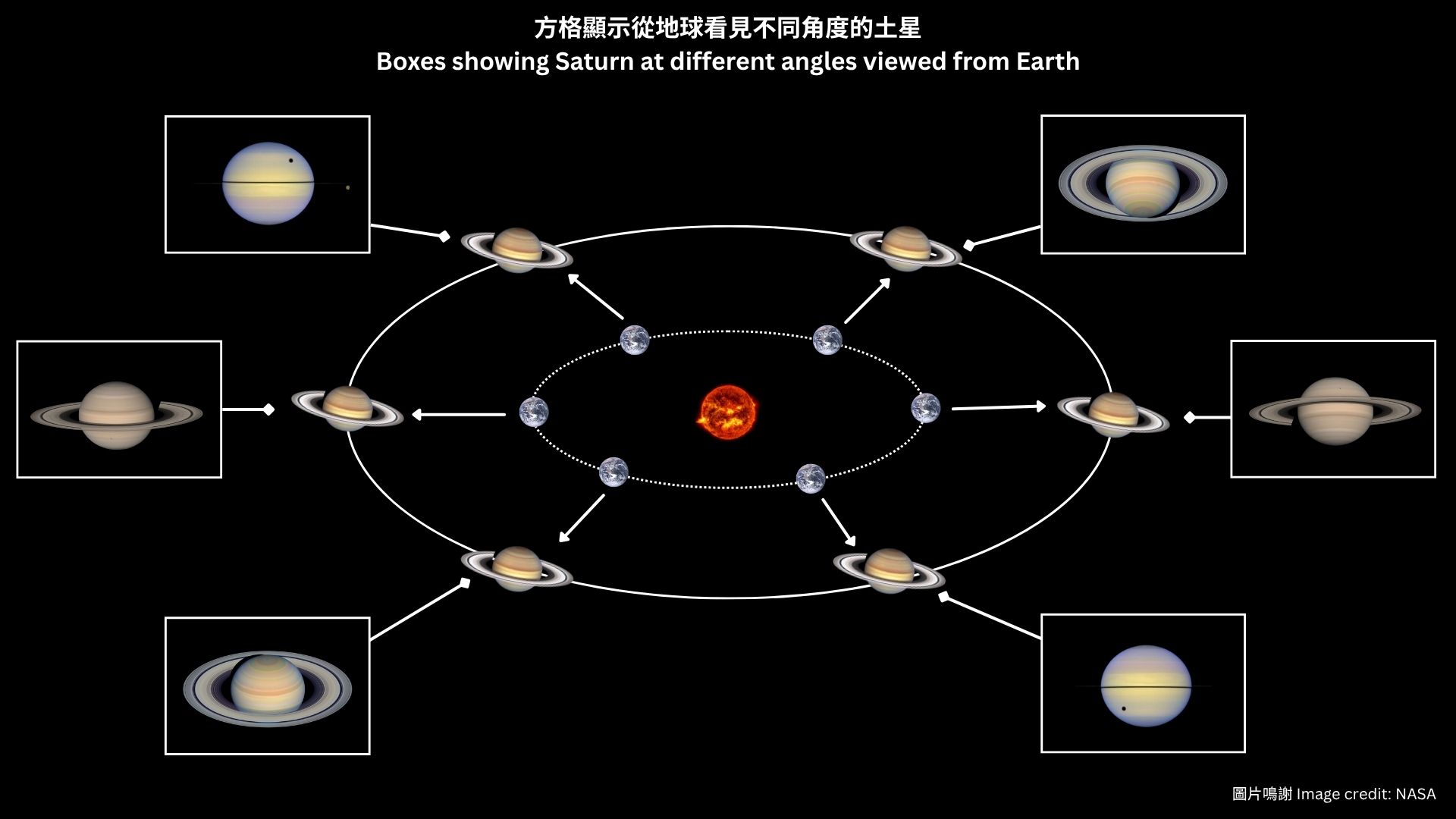
Each round of phenomenon happens roughly every 13 to 16 years, about twice during each Saturnian year. In each round, sometimes, there is just one ring-plane crossing; other times, there are three as Saturn's position shifts relative to Earth and the Sun.
When to see the rings disappear again
The recent chance came in late November 2025 when Saturn’s rings were at an edge-on angle of about 0.5 degrees. While that was not a formal ring-plane crossing, it was a good chance to try spotting the ultra-slim rings with a telescope under steady skies.
Saturn’s rings will be edge-on to us three times in total during 2038 and 2039. Of these, the event predicted for 1 April 2039 will likely be the easiest to observe, as Saturn will be near opposition and visible for most of the night.
Why this matters
Ring-plane crossings are not just spectacular illusions; they are valuable scientific opportunities. When the rings appear edge-on, astronomers can better study Saturn’s moons, which are usually outshone by the bright rings. These events also help scientists measure the rings’ thickness more precisely and discover faint rings that might otherwise remain hidden. For astronomy enthusiasts, these rare events remind us that the Universe is always changing and that these changes hold many more surprises for us.
To know more about Saturn ring-plane crossing, please view this recording of the live streaming programme (in Cantonese only):
https://www.youtube.com/live/AnQpX7_LTto?si=8JegAAedMuq8QSh5